
CHAMPIONSHIP ROUND
CHAMPIONSHIP ROUND
WINNERS
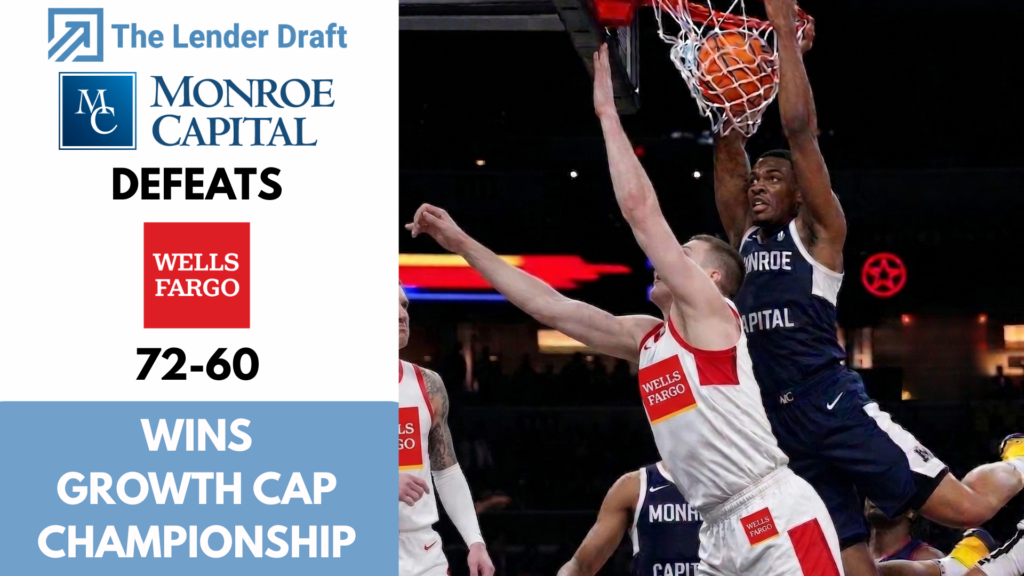
#2 Monroe Capital DEFEATS #1 Wells Fargo 72-60
TOP ISSUES & OPPORTUNITIES FOR GROWTH CAP INDUSTRY
1) The HSR premerger notification reversion to legacy forms is a narrow, temporary window that acquisition lenders and PE sponsors are dramatically underusing right now
A federal district court vacated Biden-era expanded HSR rules in February 2026, and the Fifth Circuit refused to stay the ruling — so the FTC and DOJ are now accepting the old, far less burdensome premerger notification forms. The 2025 expanded form had added months of diligence burden, disclosure of minority investors, board observers, and labor market impacts, all of which routinely delayed closings and extended standby financing commitments..
Groups That Benefit:
- PE sponsors with pending acquisitions requiring antitrust clearance: Compressed review timelines mean faster closes and lower carry costs on bridge and acquisition financing.
- Acquisition lenders and direct lenders underwriting LBO facilities: Shorter commitment windows reduce exposure to market flex and interest rate drift between signing and close.
- M&A advisory firms in the $50M–$500M deal range: A deal market that was gummed up by regulatory friction just got a temporary lube job; advisors who move deals now capture fees others are waiting on.
2) The Strait of Hormuz blockade and Islamabad peace talks are creating a compressed, binary refinancing window for energy infrastructure and industrial growth borrowers, and most are missing it.
Brent crude above $95, SOFR at 3.65%, and U.S. inflation at 3.3% driven by energy shock creates a precise convergence problem for growth capital borrowers in energy, manufacturing, and supply-chain-dependent sectors: their revenue environment is inflated by commodity pricing, their debt service is elevated by floating rates, and the moment Hormuz reopens and energy prices normalize, their revenue base deflates while their debt obligations don’t.
Groups That Benefit:
- Energy infrastructure and critical materials lenders: Macquarie’s dual energy deals this week confirm that project finance for domestic industrial assets, such as iron ore and data center power, is open and well-priced.
- Supply chain finance providers: Elongated cash conversion cycles from Hormuz rerouting mean importers need bridge liquidity; supply chain finance utilization is spiking exactly when availability is tightest.
- Domestic manufacturing growth borrowers: U.S. reshoring narratives gain genuine funding momentum when global supply chains are demonstrably broken and Mesabi’s $2.5B DR-grade iron ore project is the physical proof.
3) The European Investment Bank’s first-ever direct investment in a small satellite launcher, a €30M venture debt facility to PLD Space, is the quiet signal that sovereign venture debt is becoming a structural competitor to private growth capital in deep-tech sectors globally.
The EIB’s €30M venture debt loan to PLD Space for the Miura 5 rocket, guaranteed under the InvestEU program, didn’t make commercial finance headlines but it should have. PLD Space raised €180M in Series C equity from Mitsubishi Electric just weeks earlier, meaning this company accessed €210M in combined capital in under 60 days using a structure that pairs institutional equity with sovereign venture debt, not private credit. As the EIB expands its New Space portfolio across companies like Aerospacelab, Sateliot, and D-Orbit, European and defense-adjacent deep-tech companies are building out a parallel capital stack that doesn’t need U.S. private credit at all. For U.S. growth capital lenders targeting aerospace, dual-use tech, and autonomous systems, that’s a direct origination competitor they haven’t priced in.
Groups That Benefit:
- European deep-tech founders: Sovereign-backed venture debt at below-market pricing with InvestEU guarantees is structurally cheaper and less dilutive than U.S. private credit European founders who understand this are actively arbitraging it.
- U.S. defense tech and aerospace lenders who operate internationally: Firms already in the EIB’s orbit can co-invest or structure alongside sovereign facilities; those who aren’t are ceding origination ground in the fastest-growing venture sector.
- Dual-use technology platforms with both NATO and commercial customers: The combination of Mitsubishi equity, EIB debt, and NATO-adjacent commercial demand makes PLD Space’s capital structure nearly replicable for other companies at the intersection of commercial space and defense.
FINAL FOUR ROUND
WINNERS
#2 Monroe Capital defeats #1 JP Morgan 73-61
#1 Wells Fargo defeats #1 U.S. Bank 63-60
TOP ISSUES & OPPORTUNITIES FOR GROWTH CAP INDUSTRY
1) The FTC’s Debanking Enforcement Push Is a Direct MAC Clause Risk for FinTech Growth Borrowers
The FTC issued warning letters to large payment networks invoking Executive Order 14331 and Section 5 of the FTC Act, warning that deplatforming customers based on political affiliation or lawful business activity constitutes an unfair practice, and that “turning a blind eye” to third-party debanking also exposes them to federal enforcement. FinTech and BaaS borrowers depend entirely on uninterrupted access to payment rails to generate processing revenue. A Section 5 enforcement action against a payment processor in a growth lender’s portfolio wouldn’t just increase legal costs; it would trigger MAC clauses, impair enterprise value, and freeze the primary revenue generation mechanism of the borrower. Most venture debt providers haven’t modeled this risk.
Groups That Benefit:
- FinTech companies with conservative account termination policies and explicit political neutrality in their terms of service: They face lower FTC scrutiny risk, and the regulatory clarity actually improves their creditworthiness as borrowers.
- Growth lenders doing enhanced diligence on FinTech terms of service as part of underwriting: Early identification of debanking exposure IS turning a risk into a pricing adjustment rather than a surprise default.
- BaaS compliance infrastructure vendors: Demand for audit tools that verify onboarding and termination policy compliance is accelerating directly from this FTC push
2) The Hormuz Closure and Liberation Day Tariffs Are Destroying the Revenue Models of Growth Capital’s Most Exposed Borrowers
The functional closure of the Strait of Hormuz, daily transits down 94.2%, crude above $115, diesel at $5.38 nationally combined with universal 10% tariffs and up to 50% reciprocals on 57 countries, is creating a violent, simultaneous cost shock for growth-stage companies in logistics, e-commerce, manufacturing-adjacent SaaS, and supply chain technology. These are sectors that venture debt and growth equity lenders have aggressively funded over the past three years on growth narratives that assumed a relatively stable cost environment. That assumption is now structurally incorrect, and the EBITDA projections and ARR growth rates embedded in current credit agreements need to be stress-tested against a world in which diesel is 40% higher and maritime lead times are 60 days longer.
Groups That Benefit:
- Growth-stage domestic energy technology companies: Crude above $115 is accelerating enterprise spending on energy optimization software, a direct revenue tailwind.
- AI-powered supply chain visibility and rerouting platforms: The chaos is creating immediate, high-urgency demand for the exact products these companies sell.
- Domestic defense and aerospace technology borrowers: They are shielded from the tariff impact and fortified by a projected 13% DoD budget increase, their growth trajectories are insulated from the macro shock.
3) IQM Finland’s €50M BlackRock Debt Facility Is the First Institutional Signal That Quantum Computing Is Entering the Growth Lending Asset Class
IQM Quantum Computers, a Helsinki-based full-stack quantum computing company, closed a €50 million financing package from funds and accounts managed by BlackRock and secured prior to IQM’s announced plans to become the first publicly listed European quantum company through a SPAC merger with Real Asset Acquisition Corp. BlackRock structured this as debt, not equity, explicitly citing that the facility lowers IQM’s overall cost of capital and improves capital structure flexibility. That is institutional credit underwriting logic being applied to quantum computing infrastructure for the first time at scale. For U.S. growth lenders who have treated quantum as a “not yet” asset class, this transaction signals that the “not yet” window is closing faster than the venture narratives suggested.
Groups That Benefit:
- Growth lenders who have been building quantum sector expertise quietly: The BlackRock facility validates the asset class and creates pricing benchmarks that early-mover lenders can use to structure competitive facilities.
- Quantum computing companies with on-premises deployment models and institutional customers: IQM’s direct-ownership customer model creates a more predictable, hardware-anchored revenue stream than cloud-only quantum providers, which is a better growth credit structure.
- European deep-tech growth borrowers generally: The IQM facility signals that institutional debt markets are open for frontier technology companies with credible hardware roadmaps, not just software.
CHAMPIONSHIP GAME MATCHUP
#2 Monroe Capital vs. #1 Wells Fargo
ELITE 8 ROUND
WINNERS
West Region: #1 JP Morgan (beats #2 KeyBank 73-61)
South Region: #1 Wells Fargo (beats #6 Bank of America 81-69)
East Region: #2 Monroe Capital (beats #1 PNC Bank 72-60)
MidWest Region: #1 U.S. Bank (beats #7 Deutsche Bank 66-62)
THIS WEEK’S TOP INDUSTRY WINNERS
1) Apollo and Ares Gate Their Funds and the Middle-Market Growth Capital Queue Just Got Longer
Redemption requests hitting 11.6% at Ares Strategic Income and 11.2% at Apollo Debt Solutions — with both funds capping withdrawals — traps roughly $4.6 billion in place and freezes the capital recycling engine that feeds unitranche and club deal origination for middle-market growth borrowers. Direct lenders hoarding liquidity for portfolio defense means new origination slows, and PE sponsors with portfolio companies mid-refinancing cycle are going to discover their go-to growth lender is suddenly very focused on triage. The borrowers who feel it first are growth-stage companies with near-term maturities that assumed the private credit window would stay open.
Groups That Benefit:
- BDCs with closed-end, externally-managed structures, because they don’t face retail redemption pressure and can selectively take origination that bounces out of the gated fund queue.
- Horizon Technology Finance and Monroe Capital, both active in the deal data this week with new facilities, because lenders who are visibly deploying capital gain immediate relationship leverage when the gated-fund alternatives dry up.
- Traditional bank credit facilities with real deposit bases, because growth-stage companies locked out of the private credit market need somewhere to go and regulated lenders look comparatively liquid.
2) Jushi’s $160M Cannabis Refinancing at 12.5% with Insider Participation Tells You Exactly How Distressed Growth Capital Is in the Sector
Jushi Holdings refinancing its entire senior secured and second lien debt stack into a $160 million term loan at 12.5% with a 4% OID — and having its own CEO and a founder fund $49 million of it themselves — is one of the more revealing growth capital data points of the week. When the people who know the business best are the ones willing to lend to it at those terms, that’s not a confidence signal. That’s a market signal about how few institutional growth lenders will touch cannabis at any price, and about how distressed the sector’s refinancing options have become. For growth capital lenders surveying sector credit quality, the 12.5% + 4% OID structure on a non-amortizing term loan with no conversion feature is the cannabis market screaming that external capital is effectively unavailable at rational cost.
Groups That Benefit:
- Specialty finance lenders like FocusGrowth Asset Management willing to lead cannabis deals, because they’re getting paid 12.5% plus OID with first priority liens and no dilution risk to equity holders — a genuinely attractive risk-adjusted return if you have the appetite.
- Cannabis operators with clean capital structures who avoided the refinancing trap, because the distress of competitors creates market share opportunity as weaker operators face covenant pressure.
- Distressed debt funds tracking cannabis credit deterioration, because the insider-funded structure signals that conventional institutional capital has largely exited the sector and distressed pricing is available.
3) Avenue Capital’s Milestone-Gated $25M Structure for Turn Therapeutics Is the Growth Lending Template That Non-AI Borrowers Need to Study
This one didn’t make headlines, but it should have. Avenue Capital Group — through its Venture Opportunities Fund II — structuring a $25 million growth capital facility for Turn Therapeutics with $7 million funded at close and $18 million gated behind clinical and corporate milestones is a precise articulation of how sophisticated growth lenders are managing binary clinical risk right now. The structure explicitly ties capital availability to Phase 2 readout performance, which means the lender isn’t betting on the science — they’re betting on the sequencing, and they’ve built the documentation to force that conversation at every tranche gate. For growth capital lenders covering life sciences, this is the framework to benchmark against.
Groups That Benefit:
- Specialty growth capital lenders with life science practices like Avenue Capital, because milestone-gated structures allow aggressive headline facility sizes while preserving credit discipline — $25 million of exposure that’s actually $7 million until the borrower earns the rest.
- Clinical-stage biotech companies with compelling Phase 2 data approaching a readout, because the Avenue/Turn structure demonstrates that venture debt is available for this profile if the milestone architecture is clean.
- Life sciences brokers and advisors who understand how to structure milestone-gated term sheets, because borrowers who don’t understand the mechanics will over-negotiate upfront and leave capital availability on the table.
FINAL FOUR MATCHUPS
#1 JP Morgan vs. #2 Monroe Capital
#1 Wells Fargo vs. #1 U.S. Bank
SWEET 16 ROUND
WINNERS
West Region: #1 JP Morgan, #2 KeyBank (close win by 3)
South Region: #1 Wells Fargo, #6 Bank of America
East Region: #1 PNC Bank, #2 Monroe Capital (close win by 2)
MidWest Region: #1 U.S. Bank, #7 Deutsche Bank
BIGGEST UPSET WIN: #7 Deutsche Bank win over #3 Santander Bank
THIS WEEK’S TOP INDUSTRY WINNERS
1) JP Morgan and PNC Bank Are Running Away from the Growth Capital Bracket — and Their Deal Flow Proves It Wasn’t Luck
JP Morgan (89 Sweet 16 score, advancing to Elite 8 over Goldman Sachs’ 61) and PNC Bank (bracket-high 105 Sweet 16 score, advancing over CIBC’s 71) are the two most dominant performers in this week’s bracket — and both have the closed deal activity to back the scoreboard up. JP Morgan led Fifth Season’s new five-year, $500M credit facility at best-in-class terms, backing an independent studio with 36 Emmy nominations and a multi-platform content slate across Netflix, Peacock, and Amazon MGM. PNC served as administrative agent and joint lead arranger on APEI’s $130M senior secured refinancing, cutting the borrower’s spread by 375 basis points at current leverage and extending maturity to 2031.
Groups That Benefit:
- Bank-affiliated ABL and growth capital platforms with treasury and agency capabilities — JP Morgan and PNC are demonstrating that full-service relationships deliver pricing advantages and deal access that pure-play lenders cannot match right now.
- Education sector borrowers with military and institutional accreditation — APEI’s 375 bps spread reduction signals that accredited, enrollment-growth-oriented higher ed operators remain highly creditworthy credits for top-tier bank lenders willing to offer relationship pricing.
- Independent content studios with diversified platform distribution — Fifth Season’s multi-streamer revenue base (not single-platform dependent) is exactly the kind of predictable cash flow that earns a five-year J.P. Morgan commitment at favorable terms.
2) Standard Chartered Gets Bounced in the First Round — but Its $435M COFCO Ag Facility Is the Most Geopolitically Loaded Deal of the Week
Standard Chartered lost to Wells Fargo 51-123 in the first round and was eliminated early, but its deal activity this week is the most geopolitically complex transaction in the entire bracket. Standard Chartered closed a $435M sustainability-linked revolving credit facility for COFCO International — the Chinese state-owned agricultural trading giant — structured around social and labor compliance KPIs in Brazilian soy and corn supply chains. For cross-border ABL and supply chain finance lenders, this deal sits directly at the intersection of three active pressure points: U.S.-China trade friction post-IEEPA ruling, Section 122 surcharge volatility on South American agricultural imports, and the growing regulatory scrutiny around Chinese state-owned entities accessing Western capital markets. The fact that Standard Chartered — a U.K.-regulated bank — structured and closed this facility while U.S.-domiciled bank participation would have faced significant political and compliance headwinds tells you exactly who is filling the cross-border ag financing gap as American lenders pull back from China-linked credit exposure.
Groups That Benefit:
- Non-U.S. bank lenders with established China-linked corporate relationships — Standard Chartered’s cross-border positioning allows it to serve COFCO where U.S. banks increasingly cannot, generating fee income and relationship depth in a space where competition is narrowing.
- Brazilian soy and corn producers certified under recognized responsible agriculture standards — COFCO’s facility KPIs create margin adjustments tied to certified sourcing volumes, giving compliant producers pricing advantages in COFCO’s procurement chain.
- Supply chain compliance and sustainability verification firms — the social KPI structure requires external third-party verification, creating direct demand for specialized auditing services across Brazilian agricultural supply chains.
3) The Revised Basel III Endgame Is the Quiet Win Nobody in Commercial Finance Is Talking About
The Fed, FDIC, and OCC just released a heavily softened Basel III Endgame proposal — cutting CET1 requirements for Category I/II banks by 4.8% and Category III/IV banks by 5.2%. The original 2023 draft threatened to dramatically increase risk-weighting on undrawn revolving credit facilities and middle-market commercial loans, which would have forced bank-affiliated ABL lenders to exit the market, slash facility sizes, or reprice to the point of handing the whole sector to unregulated private credit. That outcome is now off the table, and the competitive dynamic between bank syndicates and direct lenders just shifted meaningfully in favor of regulated banks. For ABL borrowers, this means cheaper, bank-priced revolving capital stays available — and for PE sponsors, it means bank syndicates remain viable alongside, not replaced by, expensive private credit.
Groups That Benefit:
- Bank-affiliated lenders — preserved capital efficiency allows them to hold middle-market commercial loans at attractive ROE without the regulatory cliff that would have forced repricing or withdrawal.
- Middle-market borrowers — competition between bank syndicates and direct lenders keeps pricing rational and maintains access to lower-cost revolving facilities.
- Syndicated loan markets — reduced capital burden keeps bank participation in broadly syndicated structures viable, preserving distribution capacity.
NEXT WEEK ELITE 8 MATCHUPS
West Region
#1 JP Morgan vs. #2 KeyBank
South Region
#1 Wells Fargo vs. #6 Bank of America
East Region
#1 PNC Bank vs. #2 Monroe Capital
MidWest Region
#1 U.S. Bank vs. #7 Deutsche Bank
FIRST ROUND
WINNERS
West Region: #1 JP Morgan, #2 KeyBank, #4 Goldman Sachs, #6 Barclays
South Region: #1 Wells Fargo, #2 Citigroup (close win by 4), #5 HSBC, #6 Bank of America
East Region: #1 PNC Bank, #2 Monroe Capital, #5 CIBC (close win by 1), #6 Truist (close win by 3)
MidWest Region: #1 U.S. Bank, #4 Huntington Bank, #5 Santander Bank, #7 Deutsche Bank
BIGGEST UPSET WIN: #7 Deutsche Bank over #2 Royal Bank of Canada
TOP OPPORTUNITIES & INDUSTRY WINNERS
1. Perceptive Advisors just provided a five-year, $60 million credit facility to Pulmonx for its Zephyr Valve severe emphysema treatment, structured as $40 million drawn at close plus $20 million unfunded subject to revenue milestones. The pricing is SOFR+7% (with a 3.75% floor), and 2% of that can be paid-in-kind at Pulmonx’s option for three years. This is notable because PIK structures have become toxic in the BDC market — PIK income hit 8.8% of total BDC investment income in late 2025, signaling borrower distress. Yet Perceptive is voluntarily embedding PIK optionality into a life sciences deal, which tells you the firm views PIK as borrower-friendly flexibility rather than a red flag.
Groups That Benefit:
Hospital CFOs and ASC buyers — vendor financing availability accelerates capital equipment purchasing for new treatment modalities
Pre-profitable medical device and biopharma companies with FDA-approved products — Pulmonx’s Zephyr Valve is cleared and guideline-endorsed; PIK optionality funds commercial scale-up without equity dilution
Life sciences credit funds with clinical expertise — Perceptive understands that Medicare reimbursement visibility justifies PIK structures that software lenders can’t underwrite
2. Trinity just deployed $70 million across two FDA-approved medical device platforms in one week — Neuros Medical’s Altius nerve stimulation system and Monteris Medical’s NeuroBlate laser ablation platform — while publicly stating they’ve deployed $5.5 billion across 463 investments since 2008 with zero new software commitments announced. This is the clearest signal yet that top-bracket growth lenders are rotating capital allocation away from SaaS and into life sciences platforms with Medicare reimbursement codes, FDA clearance, and hospital buyer contracts.
Groups that Benefit:
Hospital systems and ASC buyers of minimally invasive surgical platforms — stronger vendor financing availability accelerates capital equipment procurement cycles
FDA-cleared medical device companies in neuromodulation, surgical robotics, and pain management — Trinity’s dual-deal week validates that lenders trust clinical outcomes data more than SaaS revenue projections
Life Sciences-focused BDCs and specialty lenders — Trinity operates across five verticals (Sponsor Finance, Equipment Finance, Tech Lending, ABL, Life Sciences) and is publicly tilting toward Life Sciences
3. Deutsche Bank just closed a $245 million warehouse facility for Oportun, a fintech lender that originates unsecured and secured consumer loans. This is Deutsche Bank’s first lending relationship with Oportun, which is significant because bulge bracket banks largely exited consumer fintech warehouse lending after the 2022 rate shock and subsequent defaults across subprime consumer credit portfolios. The fact that Deutsche Bank is re-entering this vertical, and doing so with a three-year revolving period signals that credit performance in consumer fintech has stabilized enough for bank balance sheets to return. Jefferies stayed in as mezzanine lender, which means the capital stack now has senior bank debt and mezzanine coverage.
Groups That Benefit:
Warehouse lending desks at European and Japanese banks — Deutsche Bank’s re-entry validates the asset class for other international lenders
Consumer fintech lenders with diversified origination channels — Oportun has $18.2 billion in lifetime originations; scale attracts bank capital
Mezzanine lenders like Jefferies willing to stay through cycles — they’re now positioned between senior bank debt and equity, capturing spread