
CHAMPIONSHIP GAME
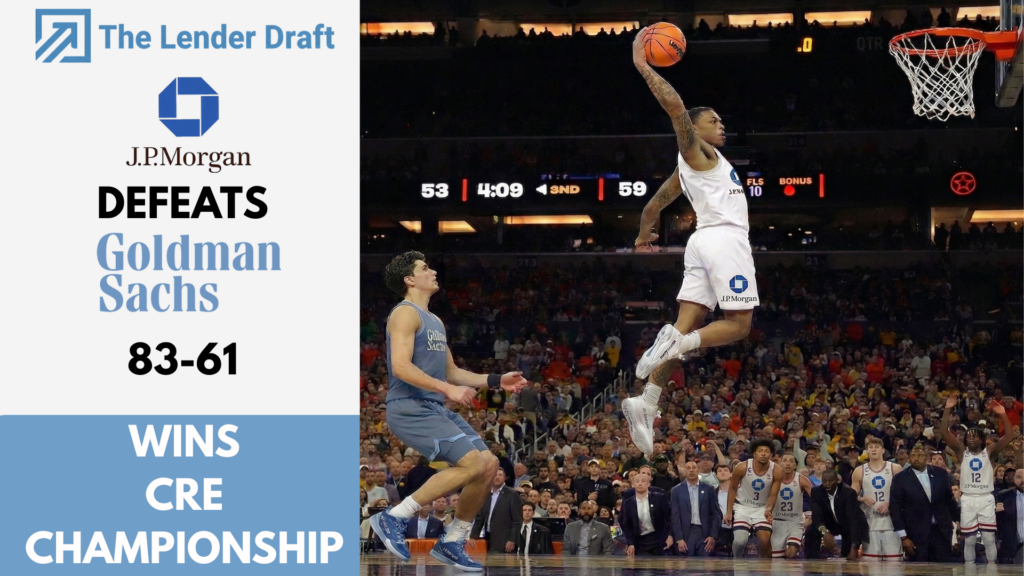
CHAMPIONSHIP GAME
WINNERS
#1 JP Morgan defeats #1 Goldman Sachs 83-61
TOP ISSUES & OPPORTUNITIES FOR CRE INDUSTRY
1) Ares Pays $1.7 Billion for Whitestone REIT as Necessity Retail Just Got Its Price Tag Stamped
This is the most important retail CRE transaction in 24 months because it sets a hard, incontrovertible institutional pricing marker for grocery-anchored, convenience-oriented suburban retail in Sunbelt markets. A 26.5% premium to pre-process valuation signals that private equity sees NAV-to-price dislocation as too wide to ignore — and it opens the floodgates for comparable REIT take-privates. For CMBS underwriters and commercial mortgage brokers, this print immediately tightens cap rate assumptions on suburban retail across Phoenix, Dallas, Houston, and San Antonio.
Groups That Benefit:
- Private Equity & Institutional Investors: The Ares-Whitestone trade validates the REIT arbitrage thesis and signals a wave of follow-on public-to-private deals as firms like Blackstone, KKR, and TPG hunt similar NAV discounts.
- Commercial Mortgage Brokers & Advisors: A hard comp this clean creates instant execution leverage when pitching retail-backed SASB or conduit structures to lenders who’ve been sitting on the sidelines.
- Appraisers and CMBS Credit Rating Agencies: This deal re-benchmarks cap rates for well-located necessity retail and gives rating agencies a defensible comp to underwrite collateral in the sector.
2) U.S.-Iran Ceasefire Sparks Violent Energy Market Repricing But the Fragility Is the Story
The 13% single-day crude oil plunge to $94.43 offers a momentary OpEx reprieve for energy-intensive property types, but the ceasefire terms with Iran still threatening to restrict Strait of Hormuz tanker traffic mean this relief is built on sand. The preceding energy spike already drove consumer sentiment down 10.7% to historic lows, which is a leading indicator of spending compression that flows directly into retail and hospitality revenue. Any lender underwriting construction or heavy value-add in 2026 needs to run a pro forma scenario where energy costs double within the next 12 months, because that’s not a tail risk it’s a live possibility.
Groups That Benefit:
- Industrial Landlords and Logistics Operators: Near-shoring demand accelerates structurally as global supply chains reprice geopolitical risk, driving occupancy and rental growth for well-located domestic logistics assets.
- Extended-Stay Hotel Operators: Lower-cost, resilient-demand hospitality product benefits from corporate travel budget rationalization; RevPAR held far better than full-service hotels during the energy shock.
- Energy-Infrastructure and Self-Powered Data Center Developers: JLL’s finding that power availability now commands a 49% rent premium validates off-grid data center investment; the Iran uncertainty just reinforced that thesis.
3) CFIUS Just Quietly Excised Chinese and Non-Allied Capital From Every Industrial and Data Center Deal Near a Military Base
The finalized CFIUS rules expanding jurisdiction to 100 miles around 19 newly designated military installations aren’t just a national security story they’re a capital markets story. The affected geography covers enormous swaths of Texas, Florida, Virginia, and California, which happen to be the most active markets for hyperscale data center development and industrial logistics. Foreign capital from non-excepted nations which excludes virtually all of Asia outside the Big Four (UK, Canada, Australia, New Zealand) now requires prolonged CFIUS clearance that functionally kills deal velocity. Every JV with Asian sovereign wealth funds or institutional investors in these geographies just got structurally complicated.
Groups That Benefit:
- Domestic Private Equity and Private Credit Funds: They’re the natural substitute for excised foreign capital; GP-LP structures with domestic LPs become the default JV structure for industrial and data center development in affected zones.
- Law Firms Specializing in CFIUS and National Security Compliance: Every affected transaction now requires expert counsel; this is a fee-generation windfall for a highly specialized bar.
- Domestic-Only Industrial Developers: Fewer eligible capital sources means less competition at the equity level, which is a quiet structuring advantage for domestic sponsors who don’t need foreign JV partners.
FINAL FOUR ROUND
WINNERS
#1 JP Morgan defeats #1 Wells Fargo 82-59
#1 Goldman Sachs defeats #5 MUFG 107-89
TOP ISSUES & OPPORTUNITIES FOR CRE INDUSTRY
1) CMBS Delinquencies Just Spiked $3.08 Billion in One Month While New Issuance Hits $32.74 Billion
The volume of CMBS loans 30+ days delinquent jumped $3.08 billion in a single month to $45.83 billion, the sharpest single-period deterioration since May 2023, driven almost entirely by 2016- and 2019-vintage office and retail loans hitting maturity walls in an environment where cap rates haven’t reset far enough for refinancing to pencil. At the same time, Q1 2026 produced $32.74 billion in new CMBS issuance, a 130% increase year-over-year, with SASB deals now at 40% of the stack. The bifurcation between legacy distress and fresh underwriting is now structural, not transitional.
Groups That Benefit:
- Special servicers: $3 billion in one-month delinquency flow is a workload bonanza, A/B restructurings, REO liquidations, and note sales are all accelerating
- Distressed-focused private equity and debt funds: Forced liquidations from special servicers will create entry points at discounts that wouldn’t exist in a healthy market
- SASB issuers and institutional investors who prefer granular transparency: SASB at 40% of market reflects exactly the flight-to-quality dynamic benefiting clean, single-asset executions with strong sponsorship
2) The Strait of Hormuz Blockade Has Pushed Brent Crude Above $115 and Officially Killed Any Remaining Hope for 2026 Fed Rate Cuts
The IRGC’s effective closure of the Strait of Hormuz has driven Brent crude from a $65-70 range to over $115 per barrel in weeks, triggering a CPI re-acceleration toward 4% and a CME FedWatch tool that now prices a 99.5% probability of no rate change at the April Fed meeting. The 10-year Treasury has moved to 4.31% and the 2-year to 3.91%, both spiking on rate-cut capitulation. For every borrower who bought an interest rate cap in late 2025 banking on a mid-2026 relief window, this is a structural trap, not a temporary inconvenience.
Groups That Benefit:
- Special servicers and distressed debt funds: Rate-cut death means the maturity wall reckoning accelerates — more forced sales, more workouts, more discounted note purchases
- Energy-independent industrial and logistics operators with long-term leases: Elevated energy costs actually tighten supply chains and raise replacement costs for competing facilities, supporting industrial
- NOI Hard money and bridge lenders who price off SOFR: 30-day SOFR stabilizing at 3.65% preserves income on the floating-rate book without forcing repricing risk that a sudden rate cut would trigger
3) Chinese Property FDI Into U.S. Gateway Markets Has Effectively Evaporated, and Nobody Is Replacing That Equity Pillar
The extended deleveraging of China’s property sector, underscored by Country Garden’s 39% year-over-year revenue collapse despite a court-engineered return to profitability, has permanently altered the global capital flow picture for U.S. trophy assets. Chinese foreign direct investment into Western CRE has functionally gone to zero. For the last decade, Chinese institutional and sovereign capital was a meaningful underwriter of demand for gateway city office and hospitality assets, providing the marginal buyer that kept cap rates compressed on transactions that domestic capital alone couldn’t fully support. That bid is gone, and no single capital source has stepped in to replace it at scale.
Groups That Benefit:
- U.S. and Canadian institutional equity buyers of gateway trophy assets: With Chinese competition removed, remaining buyers face less competition at the top of the market, creating opportunities to acquire generational assets at prices that would have been bid up aggressively five years ago
- European family offices and sovereign wealth funds rotating toward dollar-denominated hard assets: A weakened Yuan and structurally impaired Chinese property sector make U.S. CRE relatively more attractive for the global allocation mandates that used to compete with Chinese capital
- Special servicers and receivers managing REO trophy assets: Reduced foreign buyer depth means trophy liquidations take longer and require more aggressive pricing, a workload and fee opportunity for specialized servicers
NEXT WEEK FINAL FOUR MATCHUPS
#1 JP Morgan vs. #1 Goldman Sachs
ELITE 8 ROUND
WINNERS
West Region: #1 Wells Fargo defeats #2 Deustche Bank
South Region: #5 MUFG defeats #6 Natixis
East Region: #1 JP Morgan defeats #6 SMBC
MidWest Region: #1 Goldman Sachs, defeats #7 PGIM
BIGGEST UPSET WIN: #7 PGIM win over #3 MonticelloAM
THIS WEEK’S TOP INDUSTRY WINNERS
1) The 21st Century ROAD to Housing Act Just Blew Up the BTR Exit Stack
The Senate’s passage of this legislation effectively bans institutional buyers (350+ SFR units) from acquiring additional single-family homes and mandates a 7-year piecemeal sell-down exclusively to individual buyers — eliminating the portfolio-premium exit that makes BTR pencil for debt and equity underwriters. Construction lenders with active forward commitments into BTR pipelines are now holding paper against a collateral type whose exit liquidity just got legislatively vaporized. The LP/GP documents, appraisal models, and LTV assumptions underwriting virtually every active BTR deal in America need to be rewritten from scratch.
Groups That Benefit:
- Individual homebuyers — they get a federally mandated 60-day first look at BTR inventory before any other buyer can step in.
- Title companies (eventually) — hundreds of individual residential closings per portfolio disposition means massive fee volume, albeit with brutal operational friction.
- Affordable housing developers — the Live Local Act lane and LIHTC-eligible multifamily capture capital fleeing the BTR sector.
2) Hormuz Ultimatum + $113 Brent = The Fed’s Hands Are Tied Until Further Notice
Trump’s Strait of Hormuz ultimatum to Iran — backed by weekend airstrikes on Tehran and a deadline extended to April 6 — pushed Brent crude above $113/barrel and triggered a 40-basis-point spike in the 10-year Treasury to 4.44% in a single month. For CRE, this isn’t a geopolitical sidebar — it’s the single biggest variable in fixed-rate mortgage pricing, forward rate lock premiums, and the viability of every floating-rate borrower waiting on refinancing relief. The market had priced in 2026 rate cuts; that thesis is gone.
Groups That Benefit:
- Agency lenders (Fannie/Freddie) — the $176B GSE cap becomes the last oasis of reliable capital as private credit retreats and the Fed is paralyzed; agency execution is now the only consistent pricing benchmark.
- Fixed-income investors holding existing below-market CRE paper — their seasoned, below-current-rate loans just got more valuable as new originations carry higher coupons.
- Energy sector CRE (industrial, data centers with onsite generation, gas-secured logistics) — energy infrastructure real estate benefits from the supply shock narrative.
3) SoftBank’s $40B OpenAI Bridge Loan Is a CRE Construction Cost Signal in Disguise
SoftBank took a $40 billion bridge loan from JPMorgan, Goldman Sachs, Mizuho, SMBC, and MUFG to fund its stake in OpenAI’s $110B round — and the second-order effect for CRE is buried in the data center supply chain. AI hyperscaler capital is flowing at a pace that is physically constrained by electrical infrastructure, semiconductor fabrication, and specialized construction labor. The same tradespeople, the same steel, and the same MEP contractors building data centers are the ones pricing your multifamily and industrial projects. Data center construction captured a 274% YoY transaction surge and represents a colossal $23B single-asset forward sale — and that capital concentration is creating localized construction labor and materials inflation that no CRE sponsor’s pro forma has fully priced.
Groups That Benefit:
- Data center REITs and digital infrastructure lenders — capital is flowing at scale, with institutional sponsorship, sovereign-grade counterparties, and long-term PPAs providing bankable cash flow certainty.
- Industrial Outdoor Storage (IOS) sponsors — with 2.5% vacancy and a 17.9% rent premium over standard industrial, IOS benefits from the same supply chain and nearshoring tailwinds driving data center demand without the construction complexity.
- Specialized CRE lenders with digital infrastructure exposure — the deals are large, the sponsors are institutional, and the PPAs are investment-grade; DSCR math is clean.
NEXT WEEK FINAL FOUR MATCHUPS
West Region
#1 Wells Fargo vs. #2 Deutsche Bank
SWEET 16 ROUND
WINNERS
West Region: #1 Wells Fargo, #2 Deustche Bank
South Region: #5 MUFG, #6 Natixis
East Region: #1 JP Morgan, #6 SMBC (close win by 1)
MidWest Region: #1 Goldman Sachs, #7 PGIM
BIGGEST UPSET WIN: #7 PGIM win over #3 MonticelloAM
THIS WEEK’S TOP INDUSTRY WINNERS
1) JP Morgan and Goldman Sachs Are the #1 Seeds Still Standing — and the Deal Data Proves It
This week’s bracket results mirror the deal data almost perfectly. JP Morgan (#1 East, beat Blackstone 81–64, dispatched Peachtree Group 105–70, advancing to Elite 8) closed a $350M self-storage debt facility for Centerbridge/Reframe and provided $136M to refinance Modera Lofts in Jersey City — two very different deal types, same dominant execution. Goldman Sachs (#1 Midwest, beat Associated Bank 99–88, advancing to Elite 8 against Affinius Capital) backed Venture Global’s $8.6B CP2 LNG Phase 2 construction financing as part of the lender consortium. Both institutions are showing up in high-complexity, high-conviction capital deployments while other lenders are sitting on the sideline waiting for rate clarity.
Groups That Benefit:
- Large-Platform Sponsors and JV Equity Partners — access to JP Morgan and Goldman at scale means certainty of execution in a market where mid-tier lenders are hesitating; Centerbridge’s $350M facility and PMG/Carlyle’s $370M Society Brooklyn refi both benefited from top-seed lender relationships.
- Self-Storage Aggregators — JP Morgan’s $350M debt facility for the Centerbridge/Reframe REIT formation platform signals institutional conviction in the asset class at a moment when self-storage valuations have reset 21% from peak; this is the definition of smart-money timing.
- Institutional Multifamily Sponsors — Goldman and JP Morgan’s continued appetite for large-scale multifamily and mixed-use at the flagship level creates a liquidity floor for the best assets in the best markets.
2) Venture Global’s $8.6B CP2 Phase 2 Close Is the Week’s Most Important CRE-Adjacent Capital Event
Venture Global took a final investment decision on CP2 LNG Phase 2 in Louisiana and closed $8.6B in project financing — making this the largest standalone project financing in the U.S. bank market and bringing total CP2 financing to $20.7B. The lender consortium includes Bank of America, Barclays, Deutsche Bank, Goldman Sachs, JP Morgan, Mizuho, Natixis, RBC, Standard Chartered, and Wells Fargo, among others. For CRE professionals, the CRE angle is indirect but critical: with the Strait of Hormuz effectively shut and Ras Laffan damaged from the Iran conflict, U.S. Gulf Coast LNG capacity is now the world’s strategic backstop — and the capital markets just placed a $20.7B bet on it in a single week. The energy infrastructure financing market is consuming massive institutional capital that, in prior cycles, would have been hunting for office or retail debt.
Groups That Benefit:
- U.S. Gulf Coast Industrial and Logistics Landlords — LNG facility expansion in Louisiana is a direct driver of port-adjacent industrial demand, workforce housing needs, and logistics real estate along the I-10 and Gulf Coast corridors.
- Deutsche Bank (#2 West, beat Madison Realty 80–61, beat CIBC 79–60, advancing to Elite 8) — Deutsche’s presence in the CP2 consortium and its Sweet 16 bracket performance reflect an institution deploying aggressively across both infrastructure project finance and CRE; the dual-track execution is a competitive signal.
- Natixis (#6 South, beat Bank OZK 94–79 in bracket) and Barclays — both in the CP2 consortium and both advancing in their bracket regions; infrastructure deal participation is a leading indicator of institutional appetite, and these lenders are showing up on the right side of the energy infrastructure trade.
3) The EBRD’s Croatia Renewable Loan Is a Quiet Signal That European Sovereign Capital Is Re-Entering Infrastructure Finance — and CRE Should Pay Attention
Over 10,700 federal contracts totaling $71.1 billion have been terminated since January 2025, with 273 contracts worth $5.1 billion cut in just the past four weeks. When a federal contract hits a Termination for Convenience under the FAR, outstanding invoices and work-in-progress convert from eligible accounts receivable into termination settlement proposals, which virtually every standard ABL credit agreement classifies as ineligible collateral. The mechanical result is immediate, massive borrowing base haircuts for GovCon borrowers, with no deterioration in the underlying business required. The DOGE termination list is concentrated in consulting, social science, IT management, and DEI-adjacent programs — lenders need to know their exposure to these categories by name, not by NAICS code.
Groups That Benefit:
- U.S. Renewable Energy Project Developers — EBRD sovereign capital redirecting toward European infrastructure means less competition for U.S.-domiciled renewable projects from European capital allocators; the Blacks Creek and Crimson Orchard deals this week closed with purely North American and Asian lender consortia, which is consistent with European capital being absorbed domestically.
- U.S. Private Credit Funds with European LP Relationships — European sovereign wealth and pension capital that would have historically allocated to U.S. CRE debt is now being absorbed by EBRD-adjacent infrastructure plays domestically; U.S. private credit funds should be monitoring this as a slow-moving LP commitment dynamic, not a current-quarter problem.
- PGIM (#7 Midwest, beat MonticelloAM 72–60, advancing to Elite 8 against Goldman Sachs) — PGIM’s bracket performance reflects an institutional fixed-income manager whose global capital allocation capabilities and cross-border relationships give it meaningful advantages in a fractured international capital environment; their Elite 8 appearance against the #1 seed Goldman Sachs is the bracket’s most interesting matchup.
NEXT WEEK ELITE 8 MATCHUPS
West Region
#1 Wells Fargo vs. #2 Deutsche Bank
South Region
#5 MUFG vs. #6 Natixis
East Region
#1 JP Morgan vs. #5 SMBC
MidWest Region
#1 Goldman Sachs vs. #7 PGIM
FIRST ROUND WINNERS
West Region: #1 Wells Fargo (close win), #2 Deutsche Bank, #3 CIBC, #4 ING Capital
South Region: #5 MUFG, #6 Natixis, #7 PCCP, #8 Credit Agricole
East Region: #1 JP Morgan, #2 Citigroup, #5 Peachtree Group, #6 SMBC
MidWest Region: #1 Goldman Sachs, #3 MonticelloAM, #5 Affinius Capital, #7 PGIM
BIGGEST UPSET WINS
#8 Credit Agricole over #1 Royal Bank of Canada
#7 PCCP over #2 Bank of America
#7 PGIM over #2 Apollo Global Mgmt
THIS WEEK’S TOP INDUSTRY WINNERS
1. Credit Agricole crushes Morgan Stanley 97-71 in March Madness South Region while MUFG advances with 127-65 blowout, signaling European and Japanese lenders are dominating U.S. CRE deal flow.
Groups That Benefit:
Industrial and multifamily developers: European lenders’ appetite for stabilized cash-flowing assets creates execution certainty that U.S. regionals can’t provide.
Sponsors with cross-border relationships: Access to aggressive foreign capital creates leverage in negotiations with domestic lenders who can’t match pricing or proceeds.
Commercial mortgage brokers with international networks: Ability to place deals with Credit Agricole, MUFG, Natixis, and CIBC gives brokers competitive advantage over domestic-only shops.
2. Peachtree Group closes $103M Miami Beach Hilton construction-to-perm bridge loan, revealing hospitality lenders are betting convention center CapEx will drive sustained group business despite $100 oil crushing leisure travel. They’re underwriting convention and group business as recession-resistant while avoiding leisure-dependent assets that get crushed when $100 oil kills discretionary travel budgets. The bet: corporate convention spend is inelastic (companies don’t cancel annual conferences because gas hit $4.50/gallon), but family vacations evaporate.
Groups That Benefit:
Cities with recent convention center CapEx: Miami Beach’s $640M investment creates 5-7 years of incremental demand that underwrites new hotel supply.
Convention-adjacent hotel developers: Lenders will fund properties within walking distance of expanded convention centers because group business is contractually committed 12-24 months out.
Construction lenders with hospitality expertise: Understanding the difference between transient leisure demand and contracted group business creates underwriting edge.
3. CIBC closes $700M (US$512M) construction-to-term financing for Aypa Power’s Ontario battery storage projects, revealing that Canadian lenders are aggressively funding grid-scale BESS while U.S. banks retreat from merchant power risk. The projects were awarded under Ontario’s Long-Term 1 competitive procurement, meaning they have contracted capacity payments that eliminate merchant power risk. CIBC’s willingness to fund construction, ITC monetization, and term debt in a single package creates execution certainty that U.S. construction lenders can’t match.
Groups That Benefit:
Indigenous development partners (Six Nations): Equity participation in grid-scale projects creates long-term revenue streams and community benefits.
Battery storage developers with Canadian utility offtake: Access to integrated construction-to-term financing eliminates refinancing risk and creates faster path to NTP.
Canadian commercial banks (CIBC, RBC, National Bank): Building energy storage expertise creates competitive moat against U.S. banks that treat BESS as “too complex.”
NEXT WEEK SWEET 16 MATCHUPS
West Region
#1 Wells Fargo vs. #4 ING Capital
#2 Deutsche Bank vs. #6 CIBC
South Region
#5 MUFG vs. #8 Credit Agricole
#6 Natixis vs. #7 PCCP
East Region
#1 JP Morgan vs. #5 Peachtree Group
#2 Citigroup vs. #6 SMBC
MidWest Region
#1 Goldman Sachs vs. #5 Affinius Capital
#3 MonticelloAM vs. #7 PGIM